Creating safer, kinder community spaces: Social work at the Salisbury Community Hub Library
When you visit a public library, you expect books, a quiet space to work, and maybe a friendly ‘hello’ from the staff member behind the desk. But what you might not expect to find is life-changing support.
At the Salisbury Community Hub Library, that support comes in the form of an embedded social worker. Through a partnership between Sonder and the City of Salisbury, the library has become a safe space for people navigating complex life challenges.
For Lizzie, the social worker embedded at the library, the work is deeply human. For the hundreds of people who have crossed her path, its impact has been profound.
What is the Social Worker in Libraries program?
The Social Worker in Libraries program is a partnership between Sonder and the City of Salisbury, designed to respond to the evolving needs of the community.
Public libraries are increasingly acting as front doors to support. Cost-of-living pressures, housing instability, mental health challenges, family violence, and social isolation mean more people are turning up to familiar, trusted community spaces seeking help. Library staff are often the first to notice when someone is in distress, but they are not necessarily trained social workers.
The 12-month pilot program placed a qualified social worker on-site at the Salisbury Community Hub Library to help bridge the gap between community members and the services available to them.
The role focuses on:
- Providing immediate, person-centred support to patrons experiencing distress or complex challenges.
- Connecting people with appropriate external services through warm referrals.
- Supporting and training library staff to confidently and safely respond to complex situations.
- Developing systems and resources that strengthen the library’s long-term capacity to support the community.
Funded by the City of Salisbury, with support from the Libraries Board of South Australia, the pilot is also helping inform how library services across the state may evolve to better respond changing community needs.
922 points of connection
Since beginning in the role, Lizzie has seen firsthand how diverse and interconnected community needs really are.
“We have a lot of culturally and linguistically diverse community members who visit regularly,” she explains. “We also have a really significant population of older people. Across almost every walk of life, the big challenges we see are with people experiencing mental health and homelessness.”
These challenges rarely exist in isolation. Mental health difficulties, housing insecurity, family violence, cultural barriers and financial stress often overlap, compounding vulnerability and making it harder for people to reach out for help.
For many people, a library is one of the few remaining public spaces where they can exist without being asked to spend money, prove eligibility, or explain themselves. That makes it a powerful point of connection, but it also places emotional and practical demands on frontline library staff.
Between November 2024 and 2025, Lizzie recorded 922 community engagements, including direct conversations with patrons, phone support, and coordination with external service providers.
“That might be taking over a phone call when staff aren’t sure how to navigate it,” she explains. “Or helping an organisation organise access for an NDIS participant. It’s all part of building pathways and connections.”
Beyond individual interactions, Lizzie has also focused on building systems that will last beyond the pilot program.
“One of the first things I made was a resource directory,” she said. “It’s available in hard copy and electronically so staff can quickly find services and supports.”
Working part-time, sustainability has always been central to her approach.
“I don’t want to build something that falls apart the second I leave – I want staff to feel confident and prepared to support people, no matter what happens with funding or staffing in the future.”
Case study: A turning point for Daisy
One day, a Library Officer approached Lizzie after noticing a woman in visible distress. With consent, the woman, Daisy*, was introduced to Lizzie.
Daisy shared that she had just left a support service where she felt her concerns had been dismissed. She described feeling generally defeated, financially strained, isolated, and unsure how to move forward.
Lizzie worked alongside Daisy to unpack her situation, exploring both the practical and emotional challenges of what she was facing. Together, they identified immediate supports, including connecting her with Centrelink contact pathways, Anglicare’s Financial Wellbeing team, and the Northern Adelaide Medicare Mental Health Centre. They also began discussing Daisy’s longer-term hopes, including her desire to study and transition into a new career.
A few weeks later, Daisy returned to the library to see Lizzie again – this time with gratitude.
She shared that on the day they first met, she has been feeling extremely overwhelmed and unsure where to turn. She described Lizzie as non-judgemental, accepting and supportive, and said she felt seen and treated as human. Daisy reflected that the conversation may well have saved her life.
Inspired by the support she received, Daisy expressed a desire to pursue study in human services so she could help others the way she had been helped. She sought advice on pathways into the field and booked time with Lizzie to go through referral options and training information in more detail.
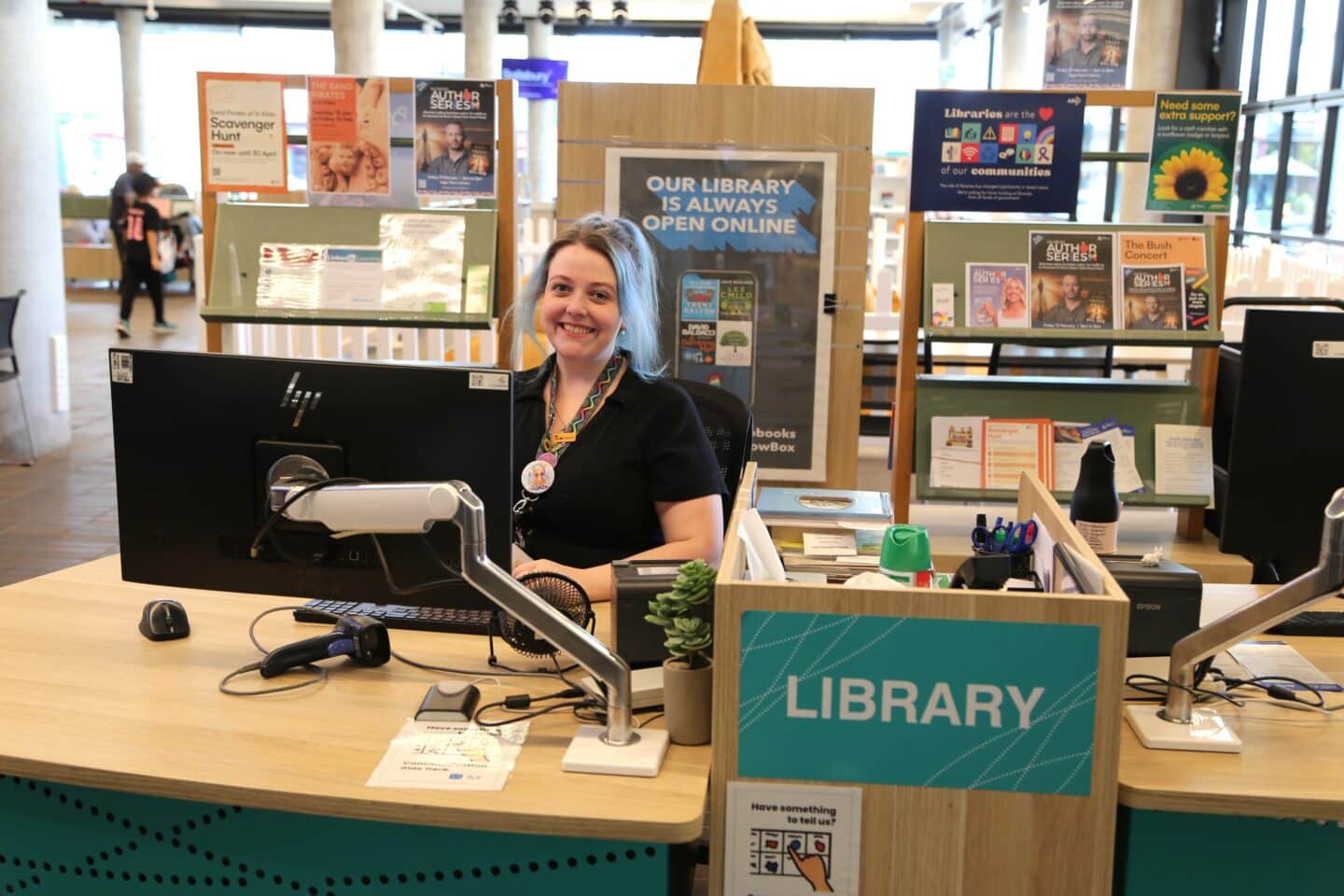
Library Social Worker Lizzie has recorded 922 engagements during the 12-month pilot program.
Supporting the people who support the community
A key part of the program has been building the confidence and capability of library staff.
Early on, Lizzie delivered training in de-escalation, communication, and practical scripting for challenging situations.
“We talked about what de-escalation actually is and how to use it,” she says. “It’s not a magical technique that suddenly fixes behaviour. It’s about setting expectations, having clear conversations, knowing when to step away, and feeling safe doing so.”
But rather than one-off training sessions, Lizzie’s approach has focused on ongoing learning and reflection.
“There’s been a lot of practice, a lot of debriefing, and empowerment,” Lizzie explained. “The training has given staff tools and perspective, and perhaps most importantly reminded them that they don’t have to handle everything alone.”
This has helped staff better understand the underlying reasons behind challenging behaviours.
In one instance, Lizzie helped staff reflect on why a woman had stolen multiple times from the library.
“We talked through possible reasons,” Lizzie recalled. “Maybe she needed to trade them. Maybe it was the only thing that gave her comfort. It’s about remembering people are human, and their actions make sense to them in their reality.”
Over time, this reframing has reduced stress for staff and created a calmer, safer environment for everyone.
Lizzie also works closely with on-site security staff to ensure responses prioritise both safety and dignity.
“The security team at the Salisbury Community Hub are brilliant,” she said. “We’ve had a fantastic opportunity to work together to ensure the human heart is cared for, as well as the safety of everyone in the building.”
Together, they review incidents, align responses with policy, and debrief after challenging situations.
“It’s not ‘security should fix this’ anymore,” Lizzie said. “It’s ‘we’re one team, how do we handle this in the smartest and most ethical way?’”
A model worth spreading
After seeing the program in action for over 12 months, Lizzie believes the model has strong potential beyond Salisbury.
“At the very least, I’d love to see one social worker for libraries per region,” she says. “Someone who can act as a central referral point and provide a place of connection. Imagine a network of support across Adelaide.”
She also credits Sonder’s multidisciplinary support as essential to the program’s success.
“If I need help supporting someone experiencing challenges with alcohol and other drugs, for example, I can turn to Sonder for support,” she says, “I can do that without hesitation, which empowers me to operate effectively. Without that support, my job would be much more difficult.”
Her advice to councils or libraries considering a similar model?
“Don’t be afraid. It might feel risky, but the impact can be extraordinary. And if the risk feels daunting, consider a model like ours, where the clinical and ethical considerations are managed by subject matter experts.”
What’s next for the program?
Originally funded as a 12-month pilot, the program has since been extended for a further six months. Lizzie, with support from Sonder and the City of Salisbury, is working on a proposal to extend it longer-term.
“I’m hoping I get to continue doing what I do,” Lizzie said. “Because I can see the help people are getting, the confidence we’re building, and the community that’s forming.”
The next phase of the program will incorporate community-led workshops and information sessions, shaped by local needs and demographic data.
Ideas include citizenship test preparation workshops and a coffee-and-chat group for older community members.
“I’m hoping that, in the next few months, we’ll get to do community engagement in fun and exciting ways,” she said. “If it’s something the community wants, it makes me really excited.”
Social work has always been here
Perhaps the most powerful insight Lizzie offers is this: social work in libraries isn’t new.
“Social work, at its core, has always been present in public spaces,” she said. “It just hasn’t always been named or properly supported.”
Libraries have long been places of refuge, learning, and connection. The Social Worker in Libraries program simply recognises that reality and provides the structure needed to support both community members and library staff.
“It’s been a problem for a long time,” Lizzie said. “Systems have been asking library staff – who may or may not have the training, the skills, the time, or support – to carry enormous emotional loads. This program shows that there’s a better way to do it.”
For the people who have found safety, clarity, or hope within the walls of the Salisbury Community Hub Library, that difference is already clear.
*Names have been changed to protect privacy.